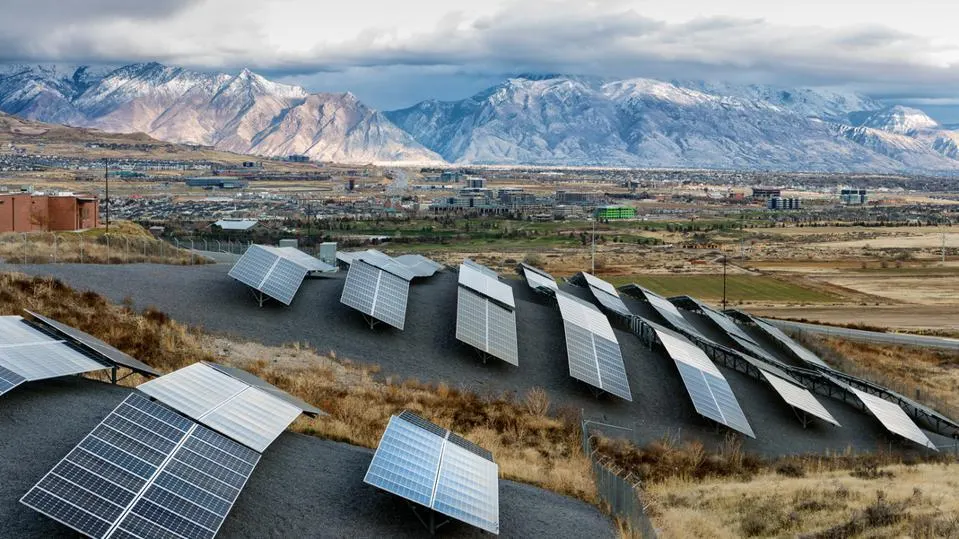
Utah Renewable Communities
Project Overview
Utah Renewable Communities (URC) is a first-of-its-kind-in-the-nation partnership between 16 Utah communities and Rocky Mountain Power (RMP), their utility. The project’s goal is to provide an annualized net 100% clean power option to participating communities by 2030 — meaning that over the course of a year, for every kilowatt-hour of power used, the utility pledges to generate an equal amount of clean energy elsewhere on the grid, without relying on unbundled Renewable Energy Credits.
URC is an opt-out program for every rate payer: everyone is automatically enrolled unless they opt out. It’s anticipated that 80% of residential, 30% of commercial, and 5% of industrial customers will remain in the program, which aims to bring up to 500 MW of new clean energy generation online. The EPA’s AVERT model predicts this shift will avoid about one million tons of greenhouse gas emissions, with roughly 25–30% of RMP’s total Utah electricity sales expected to be included.
The partnership was initiated in 2016 with a joint cooperation statement between Salt Lake City and Rocky Mountain Power. Its foundation was laid with the Community Renewable Energy Act (since renamed the Community Clean Energy Act, HB 411), which passed the Utah legislature in 2019 with a two-thirds majority and created a framework for local governments to partner with their utility on 100% renewable power. Participating communities passed a resolution in December 2019 pledging to reach net 100% renewable energy by 2030.
The program costs residential customers about $4.00 per month, $0.12 of which is an equity surcharge that makes the program free for qualifying low-income customers; commercial and industrial customers pay $0.00609 per kWh plus the same $0.12 surcharge. As of March 2026, the Utah Public Service Commission approved URC as the Utah Community Clean Energy Program (docket no. 25-035-06), with 16 of 19 eligible communities having adopted ordinances to participate: Alta, Castle Valley, Francis, Grand County, Emigration Canyon, Holladay, Midvale, Millcreek, Moab, Oakley, Ogden, Park City, Salt Lake City, Salt Lake County, Springdale, and Summit County. Similar partnerships are now being considered in Idaho, New Mexico, Montana, and Washington.
Lessons Learned
- Brand Messaging Matters — Carefully crafted messaging tailored to diverse audiences — local governments, ratepayers, the utility, and regulators — helped diverse stakeholders find common ground. Framing in terms of energy independence and affordability was often more effective than leading with “climate change.”
- Inconsistent Federal Support — Shifting federal tax credit policy created urgency for the Public Service Commission to approve the program and begin construction before incentives expired, since those credits were critical to keeping costs low for customers.
- Coordination Challenge — With at least 90 officials across participating communities needing to stay current, managing communication was a major challenge — one URC handled well enough that every member-community vote has been unanimous.
- Regulatory Process Time Sink — The regulatory process is complex and time-consuming; even determining a low-income surcharge amount required a dedicated regulatory finding, adding significant legal and technical cost.
- Risk Aversion in Federal Grant Agencies — As a new model for utility-community partnership rather than full independence, URC was harder to fund through federal grants, which tend to favor tried-and-true approaches over untested ones.
- Individual Stories Move Public Comment — In the public comment process, individual stories from residents about the visible impacts of climate change carried outsized influence in building support for the program.